List of Works
Michael Mullin & Andrea Ngan (moltoduō)
altered currents, 2025
Location: Philadelphia, PA (unceded ancestral homeland of the Lenape people)
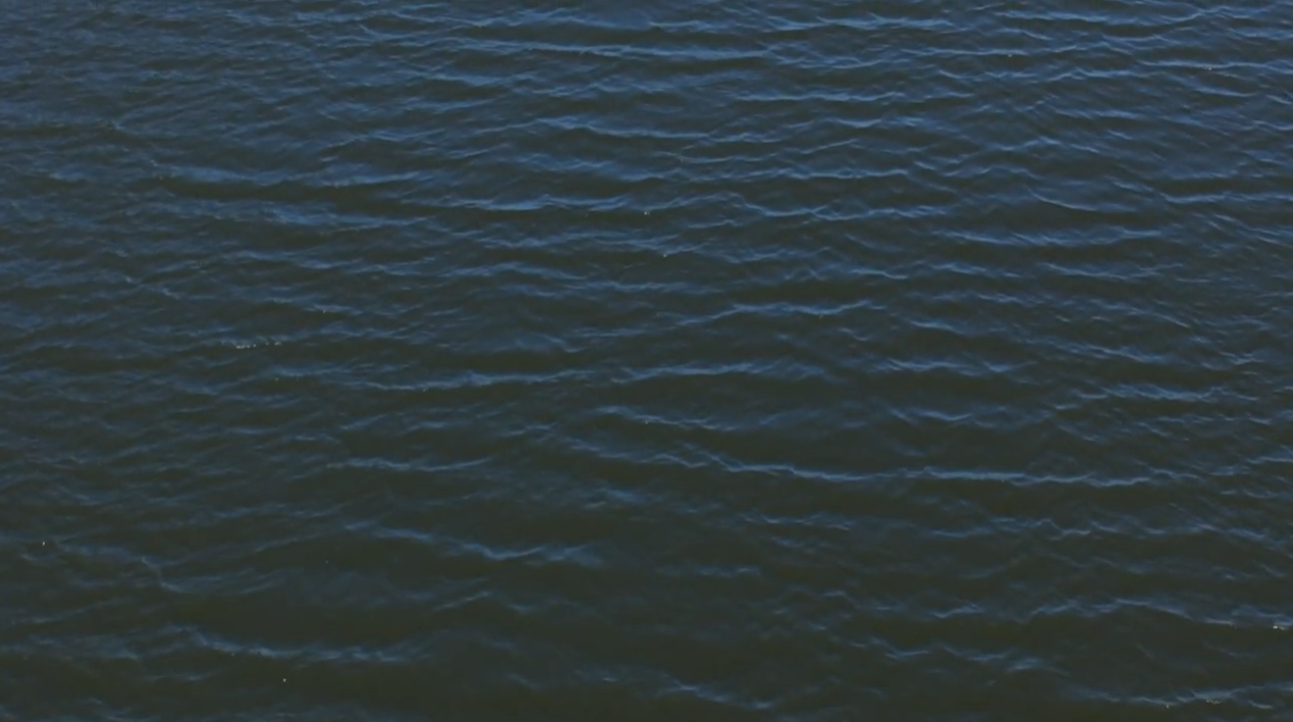
Frame: Industrial pollution and mining in the 19th to 20th centuries kept Philadelphians out of the Schuylkill river for generations. Efforts to restore and repair water quality have in recent decades brought communities in Southwest Philadelphia back into relationship with the most vital and significant river connecting so many across the region.
Mickey Oscar Boyd
The Artist Goes to Costco, 2025
Location: Athens, GA (USA)
Frame: A federally protected wetland sits behind the Costco: one of the largest retailers in the world. The artist records his round about journey from the sensitive local system to the precarious global one, which lay only 1000 ft (~300m) from one another.
Michael Kress
ANA, 2024-25
Location: Hamburg Veddel (DE)
Frame: Ana is singing a tune. The song is maybe sung in Bulgarian. Ana is daily coming to the Art Space to charge her power banks. Ana is living in the park. Ana is gone.
Samuel Hamish Horgan
Super Sargasso Sea, 2025
Location: Redbank Creek in New Bethlehem, Pennsylvania (USA)
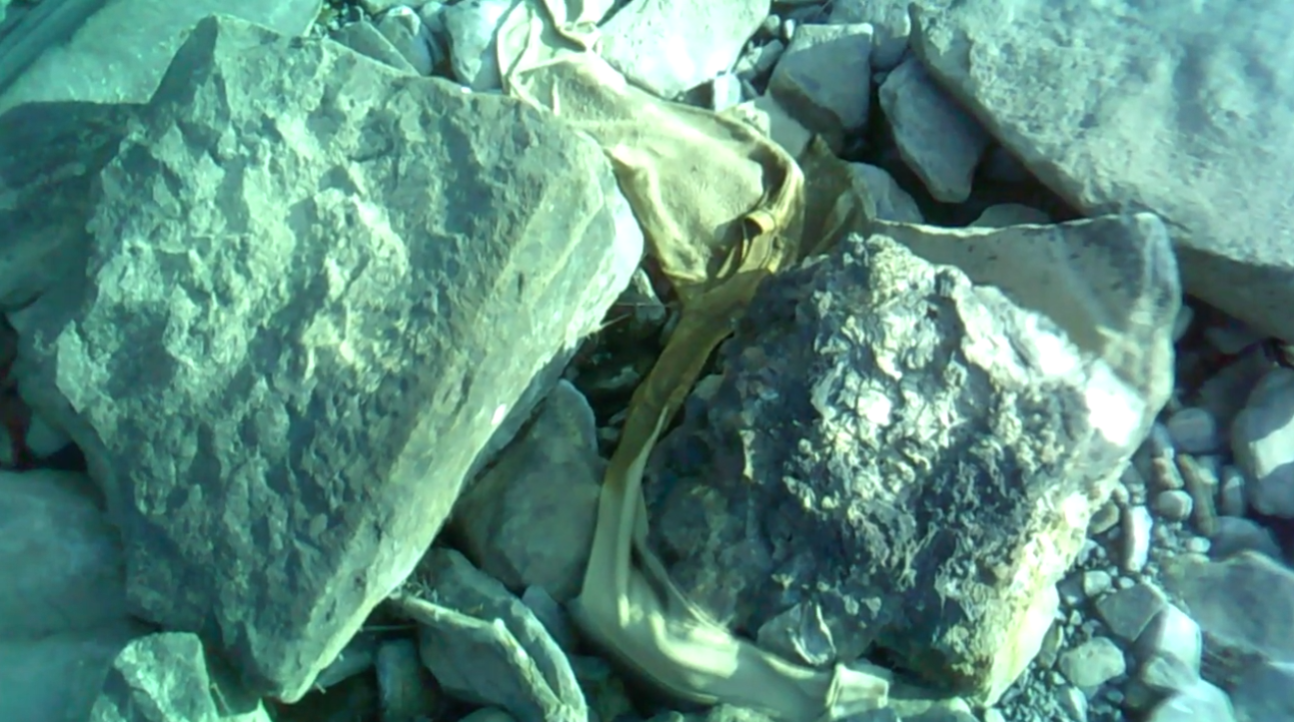
Frame: This short film essay traces notions of planetary unconscious drifting in large bodies of water, moving from Fortean phenomena to biblical exegesis. This is accompanied by scenes of creekbank flotsam beneath a ruined brick mill, along the course of a hillside tributary which will reach the Allegheny, Ohio, Mississippi, and at last, the sea.
James Enos, Forest Kelley
Inversion, 2025
Location: Amsterdam, Groningen (NL)
Frame: Not A Map, AMS–GRQ (2025) explored the canals of Amsterdam and Groningen through paper and experimental sound works. Inversion extends the project as a generative audio-visual piece built from its otherwise inaudible signals—electromagnetic traces from the ghost architecture of ports: surveillance systems, drones, ship communications, RFID scanners, radar, and data networks. The collaboration treats mapping as an interpretive process of translating lived experience into sensory form.
Charles G. Miller
Teddy (Petit Jean), 2025
Location: San Diego, California (USA)
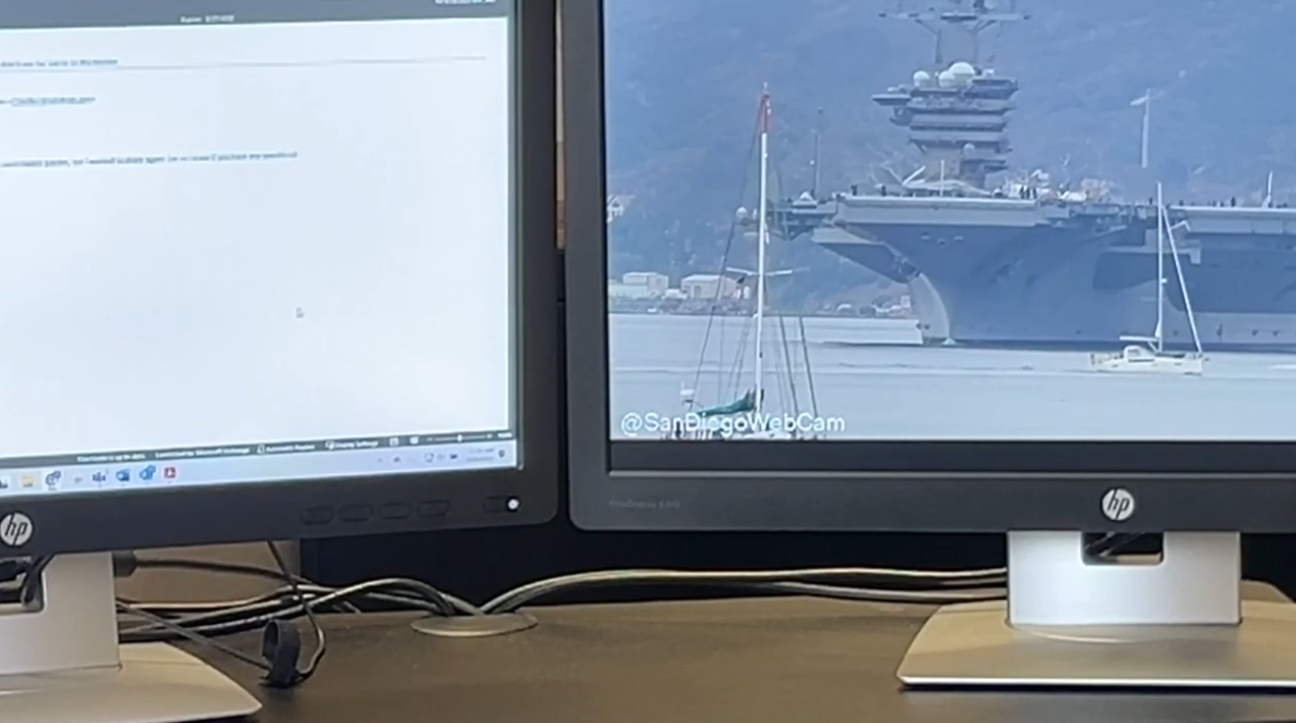
Frame: Documenting USS Theodore Roosevelt (CVN 71) by direct and remote modalities without interfering with normal work hours.
Chrisdian Wittenburg
Gebirgsbach (mountain stream), 2003/2025
Location: Sierra Nevada, (SP)
Frame: I lie down in a mountain stream and let the water flow over my head to my feet until the cold gives me a headache.
Credits: Camera, Manuel Zonouzi; Set-photography, Michael Kress
Koos Buist
Body as landscape, water as thoughts, 2022
Location: Noordpolderzijl, Groningen (NL)
Frame: The Dutch landscape is completely cultivated. Pragmatic and efficient, rivers straightened, sea transformed into land and sealed off by the dikes. Man shapes and is shaped by the landschap, Is this my mirror ? (Clip is a fragment from the movie Waddenzeevolk)
Credits: Koos Buist (film), Emil van Steenwijk (music)
Sophia Leitenmayer
About:borders2020, 2021
Location: Hamburg,GER / Athens, Lesvos, GREECE
Frame: This video highlights the intersection of humanitarian activism and the challenges posed by a global pandemic, illustrating how grassroots efforts are mobilized to address human rights violations in Europe, particularly on the island of Lesvos. It underscores the critical role that volunteers and NGOs play in filling the gaps left by governmental inaction, while also reflecting on the complexities of transnational activism amid shifting political landscapes and public health crises.
Nao Uda
My Summer Diary, 2025
Location: Yokohama (JP)
Frame: While both of my parents spent this summer in hospitals, I walked around my hometown and captured the fragments of my summer.
Xin Cheng
A Chance Encounter, 2024-2025
Location: Te Auaunga Oakley Creek, Ōwairaka, Tāmaki Makaurau / Auckland, Aotearoa (NZ)
Frame: Biking along the Te Auaunga Oakley Creek (summer 2024), I came across two endemic eels, or, tuna in Māori, possibly one longfin, one shortfin, before their migration to the Pacific Ocean
Credits: Adam Ben-Dror (editing assistance), and Wendy John (eel identification)
Tom Schram
Searching for the Reservoir, 2025
Location: Black Mountain, North Carolina (USA)
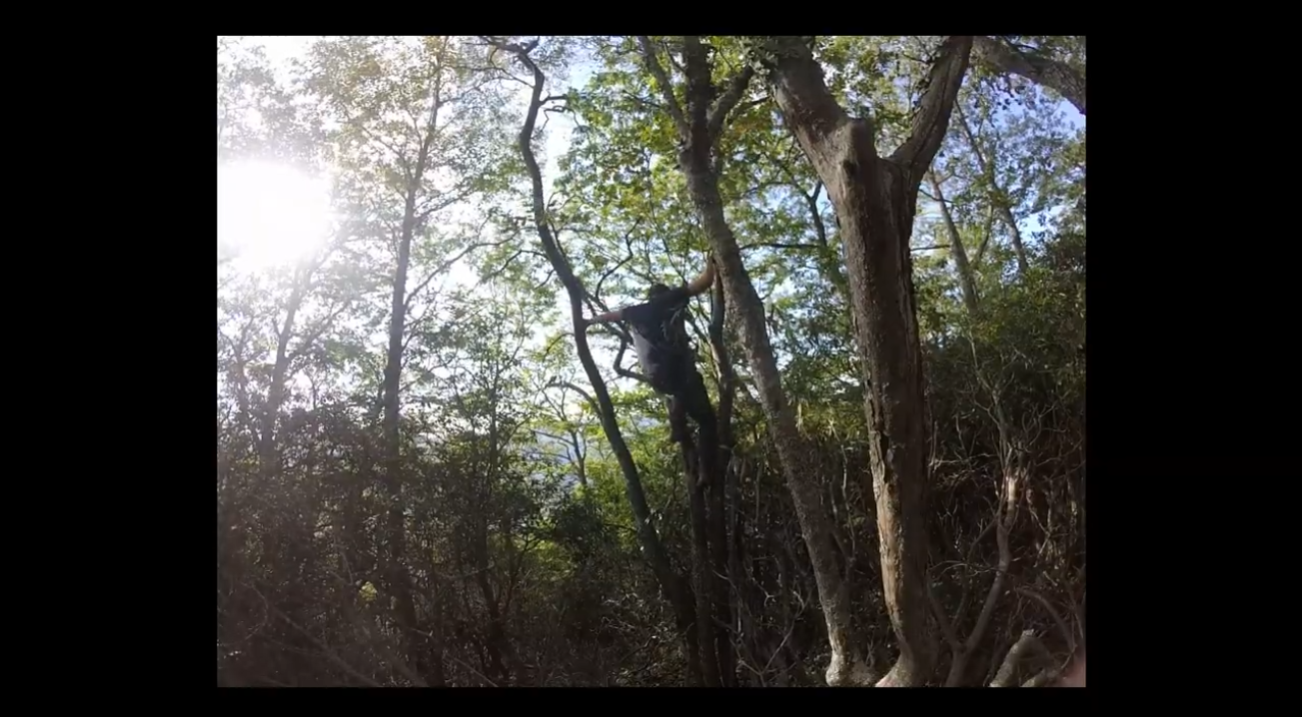
Frame: In the wake of Hurricane Helene in 2024, the North Fork Reservoir’s water supply as well as the infrastructure to supply drinking water to individuals in Asheville, NC was heavily damaged. The city was without fresh drinking water on tap for weeks. This project is an attempt to physically connect with and better understand the source of this resource, after having it taken away suddenly for such an extended period.
Jan Derk Diekema
Borderlines II, 2025
Location(s) of footage: Veddel and Hafencity, Hamburg (DE)
Frame: In recent years Diekema crossed the Freihafen Elbbrücken in Hamburg – a bridge crossing the river Elbe – hundreds of times. He documented developments and shares his findings.
Credits: HyCP, sound: self modified version of Creep - Emmit Fenn
Marin Carr-Quimet
I know you from Helene!, 2025
Location(s) of footage: French Broad River, Swannanoa River, Hominy Creek, Asheville, Western North Carolina (USA) and from various locations in and around Asheville and broader Western North Carolina.
Frame:The included video clips and photos were taken by contributors in the time after Hurricane Helene in Western North Carolina. Contributions were collected via direct communication and through sharing flyers -- meant to mirror communication channels in the days following the hurricane, and in an attempt to follow paths of connection that formed.
Credits / Contributors: Anastasia Anissimova, Reddeer Cruz, Elinor Davis, Leah Hall, Sydney Levitt, Kari Kvittem, Pat Malone, Donovan Nordellia, Sophie Payne, Annie Queeney, Taryn Shore, Bailey Smith, Mike Turner, Erin Wells
Joseph H Kennedy Jr
Duck Blind, 2022
Locations: Tidmarsh Wildlife Sanctuary, Plymouth MA; Harvard Kirkland Gallery, Cambridge MA
Frame: Duck Blind investigates simulated natures that are designed and crafted to appeal to and engage with both human and non-human audiences through an uncanny blend of mechanical abstraction and kitsch realism. A post-documentary installation & archival approach looks towards the aesthetic entanglement of natural systems and manufactured ecologies via duck decoys, simulated waterfowl intended to attract living birds in the wild, and managed wetland habitats, forms of territorial control offering “eco-system services” to offset destructive environmental impacts generated elsewhere.
Credits: Annie Simpson + Joseph H Kennedy Jr.
Matt Kaelin
The Race, March 29, 2025 (7:11–7:13 PM), 2025
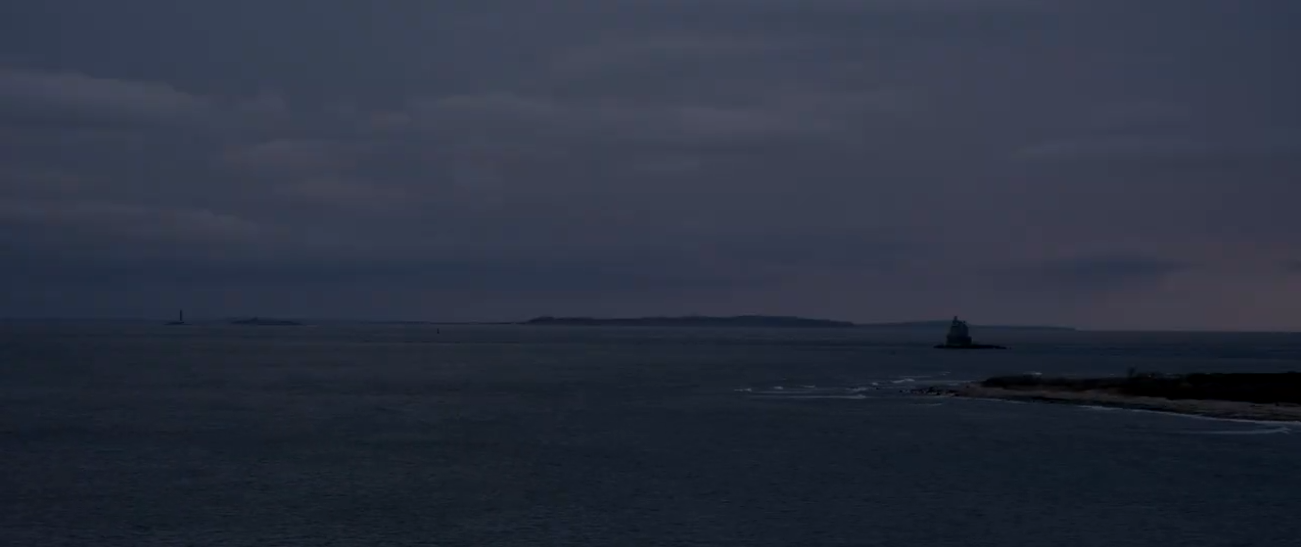
Location: Fishers Island, NY — looking SSW toward The Race
Frame: The Race, March 29, 2025 (7:11–7:13 PM)
From an elevated position on the southwest corner of Fishers Island, this two-minute video looks SSW across the full expanse of The Race—the turbulent channel where Long Island Sound meets the Atlantic. The camera remains static as the tide moves through the passage and the sun sets beyond the horizon.
Rotating captions in the lower left display data about current speed, wind, and sunset time—figures extrapolated from NOAA beacon LS1001, whose rapidly blinking green light appears at the center left of the frame. The data transforms the video into a kind of dialogue between the camera and the beacon: two instruments of observation offering their own forms of truth.
Without the captions, the scene might read simply as one of beauty and stillness. With them, it becomes a meditation on perception and translation—on how both the camera and the sensor can only describe the world in the limited languages they know: light and data.
Miku Sato
Dancing or Drowning, 2025
Location: Tashkent, Uzbekistan
Frame: The river flows, carrying life and death, circling the earth. Somewhere along the way, we drift — not knowing whether we are dancing or drowning.
Credits: filming and editing by Miku Sato
Torsten Bruch
bring apple, take apple, 2025
Location: Studio in Hamburg, Germany
Frame: A video experiment, framed by reflections on todays information mind maps.
Vijay Rajkumar
Glass, 2025
Location: Tokyo
Frame: On an early morning in January, I found myself in transit in Tokyo during an extended layover. Unsure of where in the city I was, and equipped with my camera, my experience was contextualized by full immersion in the multi-sensory rhythms of the morning commute. By extending the life-span of each video frame during playback of this memory, translucent layers of light and motion overlap, painting the indexical window of the camera's lens like stained glass.
Credits: Sound and image by Vijay Rajkumar
Annie Simpson
Linda, 2025
Location: North Sea
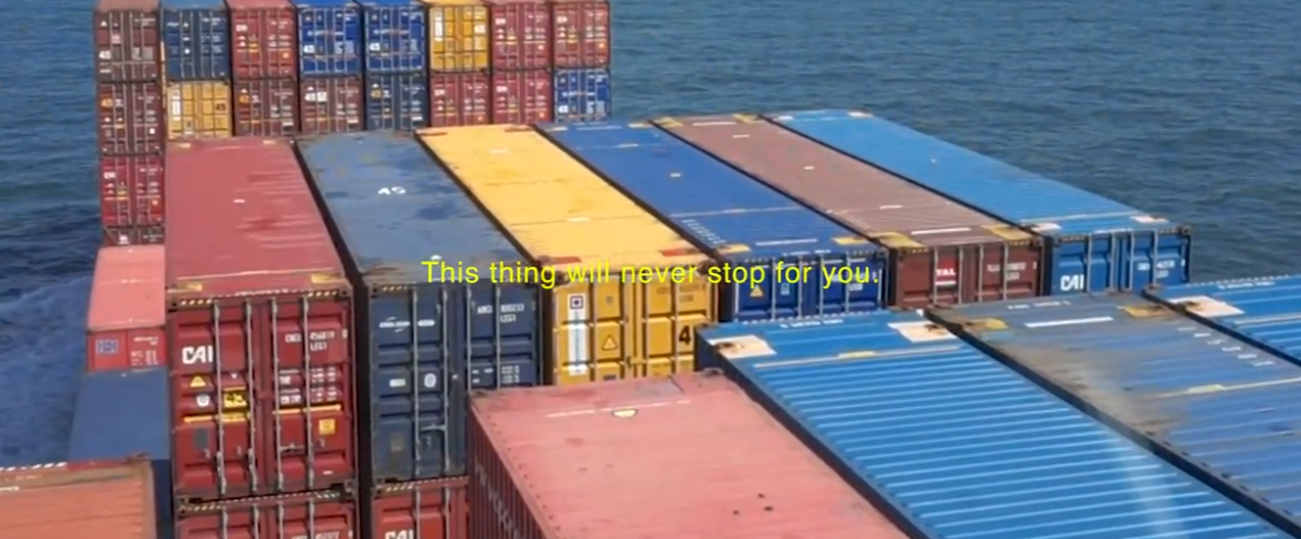
Frame: Allan Sekula likened the constant renaming of maritime vessels to a form of concrete poetry announcing the “calculated amnesia of the world of international shipping.” It is a choreography of selfhood yielding to the immediate handshake of the market, one rendered a liminal nowhere, the farthest place you’ve ever been from a navigable edge.
Credits: Project supported by the Harvard Mellon Urban Initiative. Developed in dialog with James Enos. Special thanks are due to the crew of the MV Linda.
02
2025-2026
Screening Locations: Audio Foundation (Auckland, NZ), Zou-No-Hana Terrace (Yokohama, JP), HyCp Veddel (Hamburg, DE), WEP (Groningen, NL), Harvard Graduate School of Design (Cambridge, MA), and ATHICA (Athens, GA).
To request a screening copy or arrange a public screening, please contact info.sociallogistics@gmail.com
.
The trouble in a sense
Marshalled below is a first account of points (for subsequent development) written by Annie Simpson and rehearsed in conversation with James Enos, Forest Kelley, Michael Kress, Mickey Boyd, and Tom Schram following a screening of 02 at the Athens Institute of Contemporary Arts in April 2026. It marks a framework that is provisional in form but not in concern.
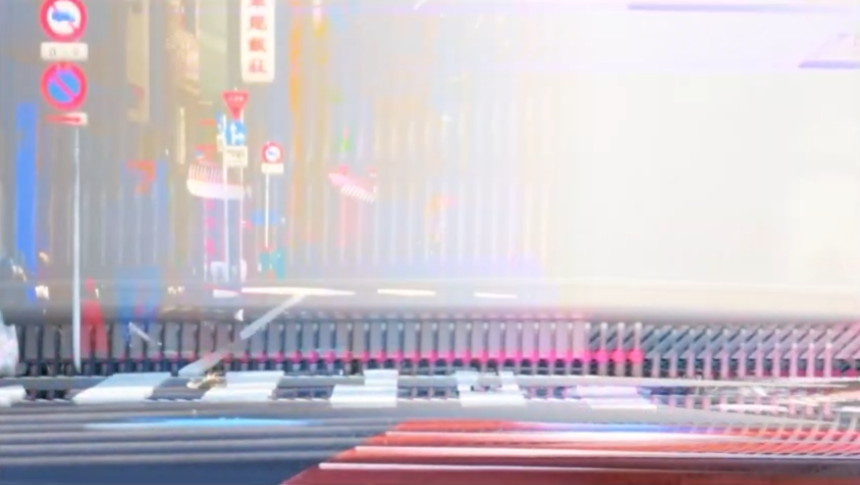
Glass, Vijay Rajkumar
a.
In our provocations for 02, we asked artists to consider, through the lenses of urgency and circularity, how we currently see rivers, wetlands, and seas within the complexity of real-time experience. This was just one attempt to stay with a series of questions initiated at the RealTimeNature Conference, hosted by myself and Joe Kennedy, with contributions from PFSL artists James Enos and Vijay Rajkumar, at the Harvard Graduate School of Design in 2024. It centered on a series of dialogs surrounding how we look at and encounter responsive environments: remote sensing, simulations and modeling, eco-mimicry, and the endurance of phenomenological approaches to registering change.
As PFSL engages the logistics of port-city-hinterland geographies, we’ve come to know trade networks, in their contemporary form, as shaped by the technical processes listed above, to increasingly present themselves as self-evident and frictionless. Take, for example, automated off-shore ports and free trade zones, or the total visibility of market or climatic modeling. What is most difficult to register within this condition is precisely how the world is continuously translated into these governable formats that simultaneously describe circulation and actively participate in organizing it - and the rest of contemporary life downstream.
At this point, spaces of circulation can no longer be treated as apart from the media systems that make them actionable, and we are thus compelled to understand them as responsive environments. (The “smart city” is a familiar example.) Part of a longer history, which is only helpful tracing in brief here, “responsive environments” was a term coined in the 1960s by the Architecture Machine Group, a lab at MIT led by Nicholas Negroponte; it would later become the MIT Media Lab. AMG’s early experiments in computation reframed architecture as a responsive system, like the late-70s Media Room. Wall-sized panoramic projections turned interior space into a moving trompe l’oeil of the exterior world, making the room itself an interactive terminal. Speech recognition, wrist-mounted sensors, and joystick controls registered and responded to the user, continuously reorganizing image-space around them, and the changed image then became the next field, soliciting the user’s gesture, command, and attention.
While such developments expanded the repertoire of the design fields, the significance of this shift was not only technical. It displaced an older understanding of space as a bounded container for activity, recasting it as an active surround, a machine capable of first perceiving, communicating with, and then adapting to its user. Under this paradigm, space is composed through relations between humans and non-humans, buildings and machines, and even technological and ecological (and biological) processes themselves.
Crucially, however, the cunning invention was not only the dawn of a new type of command, one under which our environments would respond to us in real time. It was the complete inversion of that relationship: response became a means of direction. The responsive environment did not simply answer the user; it returned the user’s own actions as an altered field, shaping the very atmosphere they could perceive and act within. I’m reminded here of Peter Sloterdijk, and though he makes this point with respect to broader anthropogenic change, it sharpens my understanding of responsive environments: no longer standing behind experience as scenery (operable or inoperable), they press back upon us as an active condition of movement, perception, and agency.
Once the environment is understood in this way, spatial practice can no longer be limited to the arrangement/composition of objects; it becomes a means of always at once (re-)organizing the conditions that produce actions and forms of conduct. Governance follows suit, moving from the administration of a discrete spatial order to the real-time modulation of behavior in process, where agency is conditioned in anticipation.
Under these conditions, a different experience of time is drawn into being. The responsive environment cannot wait; it registers movement as it emerges, continually returning an adjusted field before anything has fully settled into consequence. The check never hits the table. The present is held in suspense, its place assumed by the preparatory act. What now matters is not the event, or something occurring, exactly, but the moment where something can be forecast early enough to act on. In reading Orit Halpern, whose research and writing has been instrumental to my thinking here, she clarifies such a temporal register, naming it as “demo-time:” systems are perpetually tested as previews of what is to come. Outcomes are deferred; decisions are weighted against projections; everything and everywhere is in advance of itself, and none of it can be assessed, much less counted upon, in any settled way.
James and I frequently find ourselves circling why we feel compelled to register change; to witness, especially in and with places that are already so heavily sensed and monitored. Ports, which serve as critical sites within each of our contributions to 02, are landscapes organized through timing, prediction, and precision, where the movement of goods, vessels, labor, weather, and risk is continually modeled in real-time. They are responsive environments in the most literal sense. Total visibility and yet these environments become most difficult to perceive. Wetlands, dredged channels, and many of the places we encounter in 02 take on this quality: material landscapes, certainly, but also fields of calculation, where things as unstable as tides or sediments are tracked as moving variables within systems.
Perhaps this is why we keep returning to these places, though it is never primarily about the place itself. Not unlike human attraction to complex patterns, it is about the constant erring produced by its responsiveness: the way a place governed by what might happen becomes difficult to register in terms of what is happening. Altered by every attempt to read it.
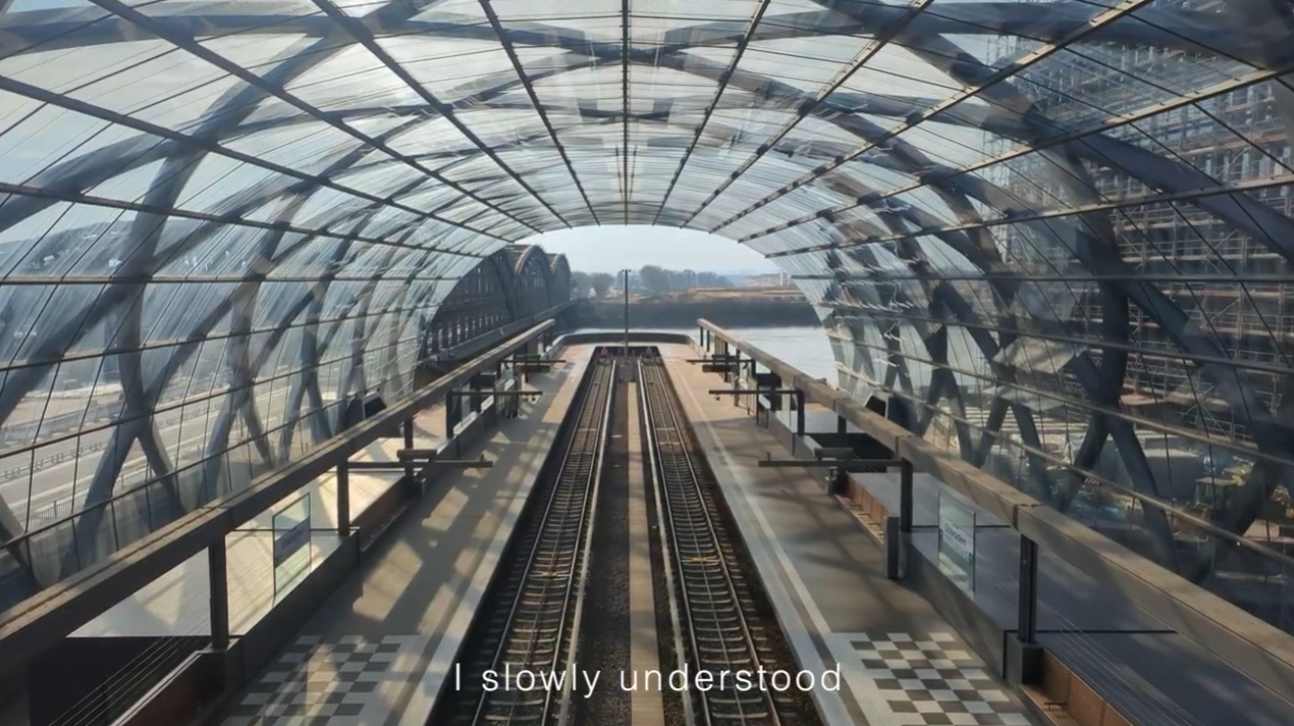
Borderlines II, Jan Derk Diekema
b.
Following the trajectory sketched above, I’d like to think that it is productive to consider each contribution in 02 as, first, an attempt to read a system that is itself in motion, one that is nonetheless, though to varying degrees, changed by perception, and second, a registration of the how the act of reading also alters the one who senses.
As a brief note, the readings that follow move through the precision of location, at times introducing details not legible in the films alone. I’d like to think of this as a method of staying with the particularity through which responsive systems become perceptible. In other words, to name the places represented in these films is neither contextual nor stabilizing; it is only an insistence that the formats that would render the world actionable only ever take hold somewhere: in situated jurisdictions, botanical inheritances, land and labor regimes, and forms of local attention. If the world cannot be fully captured by the systems that describe it, even if those systems play a role in shaping it, as I contend, this is a way of remaining answerable to the remainder, or what exceeds capture, without allowing that excess to become generic, atmospheric, or vague. Pressed far enough, it names what can be named in order to better register the breaking point.
And still, if the precision of location affords another way of engaging these works, we would fall into the same trap of capture by imagining that it offers “more” than what a more immediate encounter with sound and image would. Neither mode is neutral, nor more complete; I turn to place only as a small exercise in reading place as physical media instead of a backdrop, attending to the locations represented here as thickened fields of medial forms in their own right.
From this position, a few provisional terms begin to organize the works. Though the means and methods across the work here vary as widely as their geographies, I consider them here, rather crudely and self-consciously, through terms from maritime law that carry a kind of poetic precision. Flotsam, jetsam, lagan, and derelict; each naming a different fate of things lost at sea, and, here, a way of thinking about what becomes perceptible at the limits of responsive environments.
There are works that surface unintentionally, like debris floating after a wreck, understood here as an event that breaks from prediction (flotsam); that signify sacrifices made calculable so that circulation can continue, like cargo cast off to lighten the load of a ship in moments of crisis (jetsam); that hold their subjects in suspension and temporarily out of sight, tethered to claim and ownership and a buoy, even at the sea floor (lagan); that are sine spe recuperandi, but instead of cargo, they are environmental conditions that are no longer treated as recoverable within the system that produced them (derelict). Together, these terms offer a provisional grammar for the moments when a responsive environment becomes readable at the edge of its own coherence, and when reading it means entering the instability where it appears.
FLOTSAM
Horgan’s Super Sargasso Sea borrows its title from Charles Fort’s speculative geography of the excluded: a zone, appearing in his 1919 non-fiction Book of the Damned, in which lost things gather before returning to the world as “torrents from the earth's repressed memory,” as Horgan narrates. Fort’s Damned belongs to a genre of proto-anomalistic writing in the early 20th century, gathering reports of phenomena excluded from accepted scientific explanation. As Horgan’s camera pans over a broken brick, and then another, a t-shirt, and hewn stone, all sitting in a shallow creek, its own type of cosmic reservoir, he says, “In the beginning the universe is a formless void; when no-one was paying attention, it was filled up like a puddle in the rain.” The line, casual, almost funny, offers the work a certain ontology of the world: it is not first made coherent and then observed, rather, it fills in via matter and incident in the interval before attention.
Something here, most of it really, has missed its appointment with explanation. These objects arrive in frame detached from a discernable sequence, drenched in cyan and flickering and sparkling from overexposure. Horgan made this footage at a ruined mill somewhere along Redbank Creek, a small tributary in Pennsylvania, significant only as part of a continental drainage system, a shallow cut in the body where everything courses elsewhere from a series of unpredictable, and thus unknowable, points of departure. As if Fort could talk back, such a path would be called
“A procession of the damned.
By the damned, I mean the excluded.
We shall have a procession of data that Science has excluded.”
JETSAM
Mullin and Ngan’s (moltoduō) altered currents gives no evidence of where we are. Instead it is all surface tension, slow motion ripples across water with a resonant hum from what we can imagine is a current’s internal frequency. Without bank, shore, or horizon, it is a record of pressure. Only in the final moments do Mullin and Ngan tip the frame subtly, returning a field of possible behaviors: a river, a railbridge in the distance, a dock in mid-ground surrounded by a scattering of kayakers, all paddling in slow motion.
Though Mullin and Ngan only name it in their artist notes, the footage comes from above the banks of Bartram’s Garden, where the Schuylkill passes one of North America’s oldest surviving botanic gardens. It is a landscape whose unusual inheritance runs through eighteenth-century circulation of North American plants, where they were made legible and portable as discrete objects within Linnaean botany, lifted from their relations through a binomial system that standardized plant naming into a durable global language still in use today. That this same river would later be a river of fire - made to carry coal silt from the anthracite region and sewage and waste from the urbanizing city, as one of the most polluted rivers in American history - comes to matter because it is precisely where the material terms by which circulation could proceed were set.
Once matter can be abstracted from relation, it can be treated as if those relations were secondary, setting up a field of trade and extraction organized by the fundamental estrangement refined along these very banks. The quiet pan toward a situated horizon marks a site of repair, or perhaps only the attempt at one, where relation is formed again, but provisionally, and only across a surface of openness where we feel so alienated and small, already changed by every effort to make it legible, and changing, in turn, the forms of relation that can be made upon it.
LAGAN
Kaelin’s The Race, March 29, 2025 (7:11–7:13 PM) looks SSW from Fishers Island across the eponymous and principal channel where the Long Island Sound opens into the mouth of the Atlantic. This is a passage where water has long required mediation in order to be entered safely. Evidence of this is a lighthouse, and then another, announcing themselves with distant blinks in blue hour. They mark a series of submerged rock ledges that, when combined with the turbulent seams of waters produced when strong tidal currents tear through a constricted and irregular passage, give the Race its unruly reputation. There is an immense difficulty in keeping a mark in place here: buoys would break loose, spindles failed, and so the lighthouse, affixed to rock, emerged as the durable sign. And the camera does not move as the horizon is emptied into bands of water or land.
In the lower left, text appears and fades: just after slack, beginning to flood; westward into Long Island Sound; current speed 0–0.5 knots; flood rising to 3.1 knots by 9:09 PM; wind 15 knots NE, gusting to 30; and after a longer pause, sunset, 7:11 PM. Kaelin pulls from NOAA’s Current Predictions (a log of future tidal floods, slacks, and ebbs) at station LIS1001_1, overlooking the passage. Once made navigable by light and now made anticipatable through forecasted force, the data-laden image does not become clearer so much as answerable.
Lagan names a particular indexical relation: the mark that keeps something held in claim under a temporality that is ongoing rather than retrospective, thus maintaining relation to something beyond access rather than recording loss, as is the case with LIS1001_1. After all, oceanographic science does not measure a pre-given object called a current; it helps constitute “the current” as a scientific thing by cutting events from continuous water motion and translating them into a recurring condition, a process no less interpretive for being automated. The tether fastens the blue stillness of the image, a frame drawn into obligation with conditions it cannot fully show but can no longer be understood apart from, to a current that prediction has already begun to compose.
DERELICT
Miller’s Teddy (Petit Jean) is perversely procedural: “documenting USS Theodore Roosevelt by direct and remote modalities without interfering with normal work hours.” The time of the desk and the time of the carrier at once is the routinized condition where looking can proceed without interruption, and where such a military object remains available as a public image. Our first glimpse of it is at the edge of sight, a fuzzy carrier in a long zoom on the horizon out from San Diego, where the microphone catches mostly weather and the ordinary failures of recording on a bluff. Miller cuts to inside, where our view is trained on a desk as a computer monitor, one of two, returns, clearer now, the carrier on a SanDiegoWebcam feed, closely framed by the small traffic of sailboats moving across the foreground.
The shift does not move us closer, exactly; it only changes the register of remove. Inside, this thing that is too distant to hold becomes easier to track, and therefore stranger, because the apparatus of seeing has become so dreadfully normal. The carrier acts elsewhere, but the conditions by which it becomes visible are here, folded into the time of work and the small permissions of noninterference. Such infrastructures are responsive in the most brutal sense, organized in anticipation through war games, threat projection, risk analysis, and surveillance to rehearse action before it occurs, governing the present and presence of violence unevenly distributed elsewhere.
The everyday legibility from here depends on the feeling that one is only watching. The capacity to understand one’s own position within the system that has produced the distance is sine spe recuperandi, lost, and there is no hope for return or recovery here under this paradigm. The ship remains visible, and we all remain at work, precisely where and when I have written this, and the system remains elsewhere enough to be watched, and near enough to have already organized the terms of us watching it.
c.
For all this talk of physical and time-based media, we ought to remember that the work in 02 is art, and that it probably shouldn’t be taken for anything else. I am not staking a claim about the redemptive power of creative affect. I do not mean this innocently. Art has proven itself, relentlessly, over and over, and now more than ever, expressly capable of participating in the anticipatory forms of value that have been at stake here all along. Once detached from the sites and relations through which it was made, make it stand in for ethical concern while remaining ever so comfortably proximate to extraction; let it be the thing from which other financial operations can be drawn, securing loans without being sold, having those loans bundled and sold onward as debt, as it sits unseen in freeports, its appraised value continuing to produce leverage, tax advantage, and speculative confidence.
To call 02 art is to place it back into the heart of the shipwreck: the political economy of responsive environments, where every gesture risks becoming another signal to be captured. It is to demand that if these works carry hope, such a feeling has to struggle against the ease with which art, and feeling itself, are metabolized by the very systems they wish to disturb. The attempt here is to sharpen the difficulty of what it means to gather works together without making them available to the old promise of creative destruction, where the ruined world is asked, once again, to serve as the raw material for a “new” vision of the future that will never quite arrive, only demo-ed elsewhere, then elsewhere again, into another version of itself.
In the assemblage of works, then, the more viable line of inquiry here is how we can burden the image with relations the market and the model would prefer to strip away, like the unstable facts of having been made and received somewhere. In 02, those relations principally gather in the spaces not yet mentioned: the small intervals where the image is no longer present, when a film has stopped giving us images, but has not stopped acting on us. The next work has not yet begun, but it is already about to reorganize what we have just seen; where, for a moment, one mode of sensing remains active without an object.
We don’t quite know what to do with this for very long. Such is the conditioning of our current state, as total visibility requires the availability of images. There is a real-time reflex interior to responsive environments, and subjectivity now, to close the distance between sensing and action. In that black space, we are caught between order and reorder, and a connection, at once the real and its very predetermination, is only made in the absence of the only thing that could secure it. The moment is as unstable as the environments that each work has only partially passed through, as each has already been made available by some format, and remains uneasy within it, with the pause holding that unease before the next image gives it another form.
To read such environments as media, or dare I say art, is therefore not only to tell another story about them, but to feel, in tandem, the story alter the subject position from which it can be told. If phenomenology endures here, it does so without the old comfort of returning to a sensed world before its capture. I’d like to think that sitting with these works is a way of staying with the altered conditions of sensing even after we have learned to expect the next signal. 02 does not give us a new time outside of anticipation, exactly, but a damaged and still usable interval when the world has not yet returned to the format that would make it so readily legible, and us, briefly, not yet returned to ourselves.
Searching for the Reservoir, Tom Schram
Linda, Annie Simpson
d.
Formative sources, direct and indirect, in order of arrival
Halpern, Orit. “1943: Architecture as Machine: The Smart City Deconstructed.” In When Is the Digital in Architecture?, edited by Andrew Goodhouse. Montréal: Canadian Centre for Architecture; Berlin: Sternberg Press, 2017.
Sloterdijk, Peter. Terror from the Air. Translated by Amy Patton and Steve Corcoran. Los Angeles: Semiotext(e), 2009.
Halpern, Orit, Robert Mitchell, and Bernard Dionysius Geoghegan. “The Smartness Mandate: Notes toward a Critique.” Grey Room 68 (Summer 2017): 106–129.
Fort, Charles. The Book of the Damned. New York: Boni and Liveright, 1919.
Helmreich, Stefan. A Book of Waves. Durham, NC: Duke University Press, 2023.
Zarobell, John, "Freeports and the Hidden Value of Art" (2020). Global Studies Faculty Publications. 27.
Sekula, Allan. “Dismantling Modernism, Reinventing Documentary (Notes on the Politics of Representation).” The Massachusetts Review 19, no. 4 (Winter 1978): 859–883.